Quantum Cloud Computing: A Strategic Imperative for the Modern Data Center
The modern data center is the engine of the digital economy, but its foundational technology — the classical computer — is hitting hard limits. As Moore's Law decelerates and computational complexity accelerates, a class of challenges in materials science, pharmaceutical research, financial modeling, and AI remains beyond the practical reach of even the most powerful supercomputers.
Quantum Cloud Computing (QCC) has emerged as a viable, if nascent, response: remote, on-demand access to Quantum Processing Units (QPUs) delivered as a cloud service. QCC is not a replacement for classical computing — it is a specialized co-processor for problems classical machines cannot efficiently solve.
For data center operators, engaging with QCC is no longer a speculative research question. It is a strategic decision about future-proofing service portfolios and enabling the next generation of client innovation.
This paper examines what quantum computing actually is, why it matters for data centers, the current technical hurdles, the emerging economic model, and a phased roadmap operators can follow to integrate QCC into their offerings.
Classical computers store information as bits — definite values of 0 or 1. Quantum computers use qubits, which leverage two principles of quantum mechanics to operate fundamentally differently.
Superposition. A qubit can exist in a combination of both 0 and 1 simultaneously. Mathematically, a qubit's state is expressed as:
|ψ⟩ = α|0⟩ + β|1⟩
Here, α and β are complex probability amplitudes. The probability of measuring 0 is |α|², the probability of measuring 1 is |β|², and they must sum to 1.
A classical bit is a switch — off or on. A qubit is better visualized as a point on the surface of a sphere (the Bloch sphere), with infinite possible states between the |0⟩ and |1⟩ poles. A register of N classical bits stores one of 2^N possible values at any moment. A register of N qubits stores a superposition of all 2^N values simultaneously — the foundation of massive computational parallelism.
Entanglement. Two or more qubits can become linked such that their states cannot be described independently. Consider the Bell state of two entangled qubits:
|Φ⁺⟩ = (|00⟩ + |11⟩) / √2
Measuring the first qubit and finding 0 guarantees the second is also 0, regardless of distance. This perfect correlation is essential for complex algorithms and for quantum error correction.
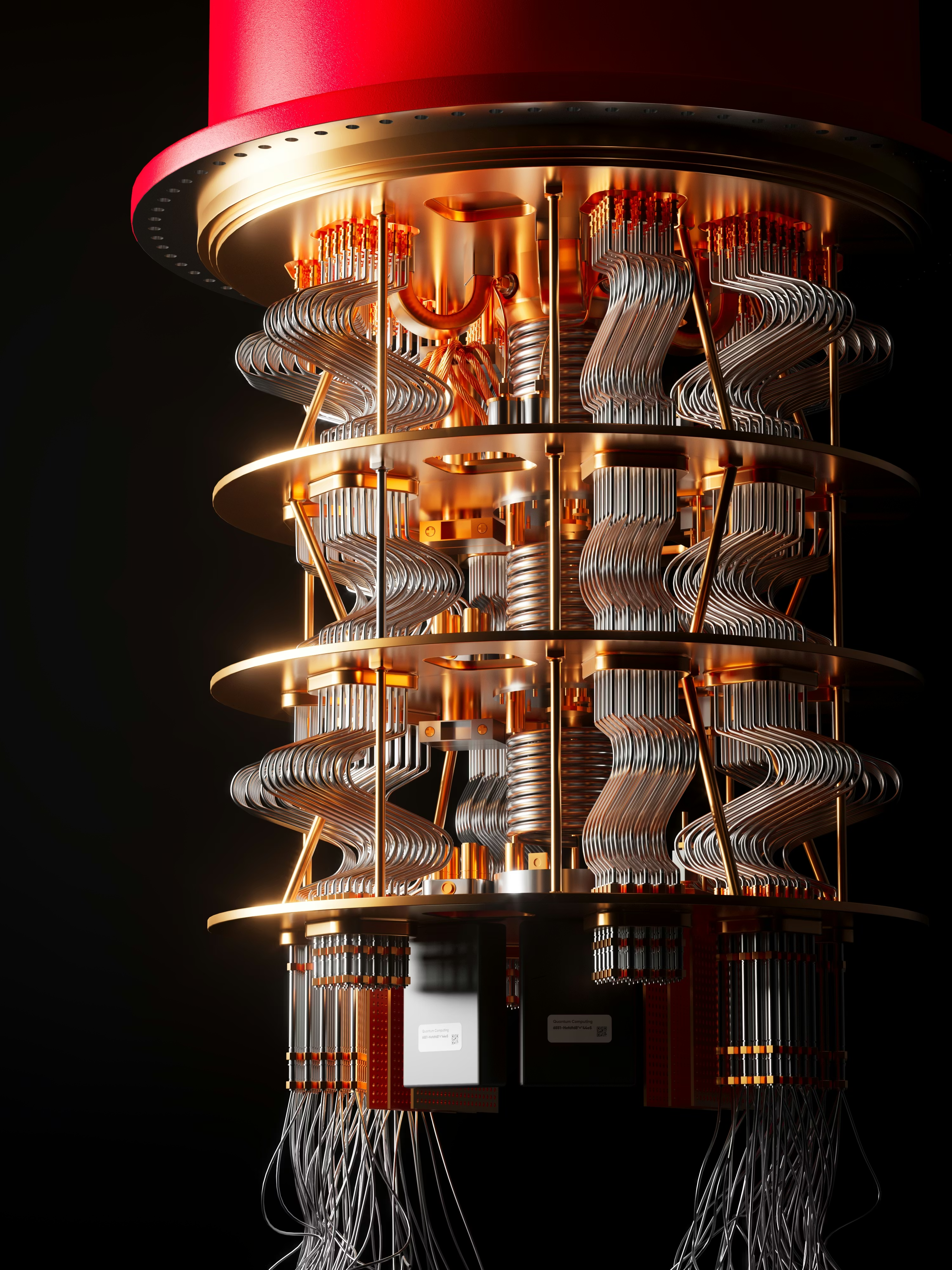
A photograph of a quantum computer shows a chandelier of golden discs and intricate wiring suspended inside a cryostat — a dilution refrigerator. The actual quantum processor is a small chip at the bottom, the coldest stage. The hardware exists for one reason: to isolate the qubits from the classical world.
- Extreme cold. The bottom stage reaches roughly 15 millikelvin — colder than outer space. Heat is random energy, and random energy destroys quantum states through a process called decoherence.
- Specialized wiring. The coaxial cables don't carry power. They carry precisely shaped microwave pulses that control and measure the qubits. Every cable is shielded to keep external noise out.
The entire machine is, in effect, a refrigerator and a Faraday cage built to give the qubits enough quiet to compute.
Quantum gates are the operations performed on qubits, executed as those microwave pulses. Key gates include:
- Hadamard (H): Creates superposition. Applied to |0⟩, it produces (|0⟩ + |1⟩) / √2.
- Pauli-X: The quantum NOT gate — flips |0⟩ to |1⟩ and vice versa.
- Controlled-NOT (CNOT): A two-qubit gate that flips the target qubit only if the control qubit is |1⟩. This is the workhorse for creating entanglement.
A quantum algorithm is a sequence of these gates designed to steer the qubits' collective state. Because measurement collapses a qubit's superposition into a classical 0 or 1 with probability determined by its amplitudes, algorithms are run many times. A well-designed quantum algorithm uses interference to amplify correct answers and cancel incorrect ones.
QCC's value is not in general-purpose computing. It is in targeted, high-value problems where classical algorithms hit a wall.
Computational chemistry and drug discovery. Simulating molecular behavior is one of the most natural applications. Algorithms like the Variational Quantum Eigensolver (VQE) compute the ground-state energy of a molecule's Hamiltonian — a task that scales exponentially on classical hardware. This dramatically accelerates pharmaceutical and materials research.
Financial modeling and optimization. Portfolio balancing, derivatives pricing, and risk management involve navigating vast parameter spaces. The Quantum Approximate Optimization Algorithm (QAOA) can find optima more efficiently than classical Monte Carlo methods, enabling superior risk management and alpha generation.
Advanced AI. Quantum Machine Learning (QML) processes data in high-dimensional quantum states. Quantum Support Vector Machines (QSVMs), for instance, can identify patterns invisible to classical classifiers — with implications for medical diagnostics, fraud detection, and pattern recognition.
Industrial and logistical optimization. NP-hard problems like the Travelling Salesman and Vehicle Routing are a natural fit for quantum approaches, with billion-dollar implications for global supply chains, manufacturing, and logistics.
Offering QCC creates clear competitive advantages:
- Capital-efficient access. Building a quantum computer requires multi-million-dollar capital investment and rare expertise. QCC converts that into a predictable operating expense.
- New computational capabilities. Clients gain access to solutions for previously unsolvable problems, opening new business models and revenue streams.
- Future-proofing. A cloud-based model means clients always have access to the latest hardware without bearing upgrade costs.
- Reduced operational complexity. Clients are insulated from cryogenic cooling, electromagnetic shielding, and continuous calibration — the painful realities of quantum hardware.
Adoption needs to be tempered by the realities of the Noisy Intermediate-Scale Quantum (NISQ) era:
- Decoherence and error rates. Qubits are exquisitely sensitive. Interactions with the environment introduce noise that limits how deep a computation can go. Robust quantum error correction remains a long-term research goal.
- Quantum Volume. Qubit count is a marketing number. The real metric is Quantum Volume, which captures connectivity, gate fidelity, and error rates together. Current systems lack the Quantum Volume needed for many commercially advantageous applications.
- Hybrid integration latency. Hybrid quantum-classical algorithms iterate between the data center and the QPU. Network latency on every call can erase the quantum speedup.
- Cryptographic risk. Fault-tolerant quantum computers will eventually break RSA and ECC — the foundation of internet security today. Data centers must begin planning the transition to Post-Quantum Cryptography (PQC)now.
QCC pricing is unlike standard cloud services:
- Consumption-based billing. Usage is measured in seconds of QPU access, number of quantum circuits executed ("shots"), or a combination.
- Reservation and partnership tiers. Major providers (IBM, Google, AWS Braket) offer reserved access through high-value enterprise contracts.
- Cost vs. value. A single complex experiment can run into the thousands of dollars. That cost is meaningful only against the potential outcome — for a pharmaceutical company, a billion-dollar drug discovery easily justifies a significant quantum compute budget.
Phase 1: Exploration and Education (immediate term).
- Train a small team of solutions architects on quantum fundamentals and frameworks like Qiskit and Cirq.
- Engage clients in finance, life sciences, and manufacturing to identify pilot use cases using free-tier services from major providers.
- Initiate a Post-Quantum Cryptography migration assessment.
Phase 2: Infrastructure Readiness and Partnership (near term).
- Optimize for high-bandwidth, low-latency connectivity to the cloud regions hosting QPUs.
- Form strategic alliances with quantum hardware providers and software startups.
- Develop a managed "Quantum-as-a-Service" offering covering problem formulation, algorithm execution, and result interpretation.
Phase 3: Full Service Integration (long term).
- Provide seamless hybrid orchestration where quantum and classical resources are provisioned within a single control plane.
- Position the data center as a regional center of excellence for quantum expertise.
The image of a dilution refrigerator hanging in a lab is a useful reminder of the extraordinary engineering needed to harness quantum mechanics for computation. But the machine itself is only an arena. The actual computation happens on a chip at the bottom, where qubits are placed into superposition, linked through entanglement, manipulated by gates, and finally collapsed into classical results by measurement.
Quantum Cloud Computing is what makes that arena accessible. It will not replace classical computing. It will sit alongside it, taking on the problems classical infrastructure cannot solve.
For data center operators, the choice is straightforward. Engage now — with education, pilots, and partnerships — and become an indispensable partner in the next era of computational discovery. Or wait, and watch competitors capture the clients who need these capabilities first.